
World's Most Important Oilseed Processing
Soybean is the world's most important oilseed, accounting for over 55% of global oilseed production. With a global annual production exceeding 370 million metric tons, soybean processing represents the backbone of the edible oil industry. Huatai's soybean oil production lines deliver complete EPC solutions covering every stage — from raw soybean cleaning and preparation, through solvent extraction, to fully refined, deodorized RBD soybean oil. Our plants are designed for maximum oil yield, minimal energy consumption, and production of high-protein meal for animal feed. We offer flexible capacities from 30 TPD for small-scale processors to 2,000 TPD for large industrial operations. Each line is custom-engineered based on your feedstock quality, target products, and site conditions. Our experienced engineering team provides complete support from feasibility study to plant commissioning.
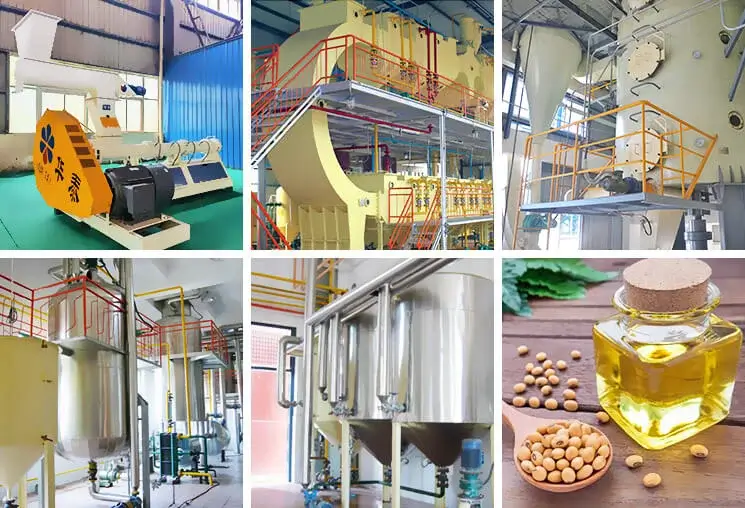
Soybean Oil Production Steps
From raw soybeans to refined, deodorized RBD soybean oil — a fully integrated process.
The line runs through 8 stages. The strip gives the sequence at a glance; the notes below cover temperatures, pressures and yields for each stage.
1. Cleaning
Raw soybeans pass through magnetic separators, vibrating screens, and destoners to remove foreign materials — stems, leaves, stones, dust, and metal fragments.
2. Cracking
Soybeans are cracked into 2-4 pieces to separate the hull from cotyledons, enabling efficient hull removal before extraction.
3. Flaking
Cracked soybean meats are flaked to 0.30-0.35 mm thickness using smooth-roll flaking mills for maximum oil cell rupture and extraction efficiency.
4. Solvent Extraction
Flakes enter a continuous chain or loop-type extractor where hexane solvent extracts oil via counter-current percolation, achieving residual oil below 1% in meal.
5. Evaporation & Stripping
Miscella (oil-solvent mixture) is evaporated in two stages followed by steam stripping under negative pressure to recover solvent and produce crude soybean oil.
6. Degumming
Water or acid degumming removes phospholipids (gums) from crude soybean oil. Lecithin can be recovered as a valuable by-product.
7. Neutralization
Free fatty acids are neutralized with food-grade alkali (caustic soda) in a continuous centrifugal neutralization system, producing neutral oil and soapstock.
8. Bleaching
Neutralized oil is treated with activated bleaching earth under vacuum to adsorb color pigments, residual soaps, and trace metals.
9. Deodorization
High-temperature vacuum steam distillation removes volatile odor compounds and free fatty acids, producing bland, stable, fully refined RBD soybean oil.
Key Equipment Systems
Each system is designed and manufactured in-house under ISO 9001 quality management.
| Pretreatment Equipment | Magnetic separator, vibrating screen, destoner, cracking mill, flaking mill, heating cooker (stack cooker or rotary conditioner), and hull separation system. Designed for continuous operation with automatic temperature and moisture control. |
|---|---|
| Solvent Extraction System | Chain-type or loop-type extractor with counter-current percolation design, DTDC (Desolventizer-Toaster-Dryer-Cooler), miscella evaporation system with first and second evaporators, mineral oil recovery system, and complete solvent recovery with tail gas absorption. |
| D.T.D.C. System | Multi-stage desolventizer-toaster-dryer-cooler for meal processing. Removes residual solvent, toasts meal to denature anti-nutritional factors, and controls final moisture for optimal feed quality. Preserves protein content above 48%. |
| Evaporation System | Negative pressure multi-stage evaporation with energy-efficient design. First evaporator (rising film type) and second evaporator (falling film type) followed by disc-and-donut stripping column for final solvent removal. Saves up to 30% steam compared to conventional designs. |
| Refining Equipment | Complete continuous refining line: acid/water degumming tanks, disc centrifuge separators, continuous neutralization reactor, vacuum bleaching tank with closed filtration, and continuous deodorization tower with structured packing. Fully automated PLC control system. |
Technical Highlights
Engineering innovations that deliver superior performance and lower operating costs.
Advanced Negative Pressure Evaporation
Our multi-effect negative pressure evaporation system saves approximately 30% steam compared to conventional single-effect designs. The disc-and-donut stripping column achieves final miscella concentration below 0.05% oil in solvent, minimizing energy loss in the distillation phase.
Continuous Refining with PLC Control
Fully automated continuous refining line with PLC-based process control. Real-time monitoring of temperature, pressure, flow rates, and oil quality parameters. Automatic adjustment of chemical dosing for consistent product quality across production shifts.
High-Protein Meal Preservation
Our DTDC system uses gentle, controlled desolventizing temperatures to preserve soybean meal protein content above 48%. Low-temperature desolventizing technology is available for production of food-grade white flakes and soy protein concentrate feedstock.
Why Buyers Choose Huatai
Since 1988 we have designed, built and commissioned complete oil mill and refining plants worldwide — one partner from layout to handover.
ISO 9001 certified manufacturing · EPC turnkey delivery · 48-hour proposal turnaround
Frequently Asked Questions
Straight answers to the questions buyers ask us before placing an order.
What capacity of soybean line do you offer?
From 30 TPD to 2,000 TPD. Most U.S. and South American clients are in the 1,000-2,000 TPD range. Smaller lines (50-200 TPD) are common in Africa and Asia.
Is full dehulling always needed?
Yes, for high-protein meal (≥46%). Without dehulling, the meal protein drops to 44%. We also offer low-hull or no-dehull configurations when the meal target is for ruminant feed.
What's the difference between chemical and physical refining?
Chemical (caustic) refining gives better oil quality (color, FFA) but uses more water and produces soapstock. Physical (steam) refining has lower losses but requires higher-grade crude oil. Most soybean plants use chemical refining; physical is used for higher-capacity lines (>1,000 TPD).
How is the meal processed for feed?
DTDC (Desolventizer-Toaster-Dryer-Cooler) reduces solvent in meal to under 500 ppm. The meal is then ground, optionally toasted, and stored or shipped. Some lines also include a hi-pro concentrate section (60%+ protein).
What's the typical oil yield?
Soybean has 18-20% oil content. With proper dehulling and solvent extraction, residual oil in meal is under 0.8%. Refined oil yield is 95-97% of crude.
Do you deliver the lecithin recovery train?
Yes, as an add-on. Lecithin is a high-value co-product, sold for food, feed, and industrial applications. Recovery from degumming water is a 2-3% credit on the refining cost.
What capacity should I choose for a Soybean Oil Production Line?
Capacity depends on how much raw material you can secure year-round, not on how much you would like to sell. Tell us your daily or monthly feedstock availability, the local season pattern and your target market, and we size the line so it runs near full load most of the year instead of sitting idle between harvests.
Can the line be expanded later?
Yes. We build these plants in modules, so you can start with pressing and add solvent extraction, refining or fractionation once volume justifies it. We reserve the floor space, utility capacity and pipe racks for the later stages during the first installation, which costs very little at the time and saves a rebuild later.
Do you handle installation and training for a Soybean Oil Production Line?
We deliver on an EPC turnkey basis. Our engineers supervise foundation setting, erection and commissioning on site, run the line through performance testing, and train your operators and maintenance crew before handover. You receive a running plant, not a crate of parts.
What about spare parts and after-sales support?
Wear parts for the presses, filters and pumps are stocked as standard and ship with the plant as a recommended spares package. After commissioning our team stays reachable for remote troubleshooting, and we can place a service engineer on site for major overhauls.
How long does delivery take?
Lead time depends on capacity, configuration and how much custom engineering your site needs. Rather than quote a number that will not hold, we confirm a firm design, manufacturing and shipping schedule alongside the proposal, broken down by stage so you can plan civil works around it.
What do you need from me to prepare a quotation?
Three things are enough to start: your raw material and its typical oil content, your target capacity in tonnes per day, and the destination port or country. Send those over and we come back with a process flow, equipment list and budget estimate. Send your requirements on WhatsApp and we will take it from there.
Get Your Customized Soybean Oil Plant Solution
Tell us your target capacity and product requirements. Our engineers will prepare a tailored proposal within 48 hours.
Send Us a Message
Fill in your project details below — our engineering team typically responds within 48 hours with a customized proposal and preliminary process flow diagram.