
The World's Most Productive Oil Crop
Palm oil is the world's most widely used vegetable oil, accounting for over 35% of global edible oil production. With yields of 4-5 metric tons of oil per hectare per year, oil palm is by far the most land-efficient oil crop available. Huatai delivers complete palm oil production lines covering the full process from fresh fruit bunch (FFB) reception to refined, bleached and deodorized (RBD) palm oil, plus fractionation into olein and stearin. Our systems serve capacities from 5 TPH to 120 TPH FFB processing. Our palm oil mills are engineered for high oil extraction efficiency (OER), minimal oil loss, and energy self-sufficiency through utilization of palm kernel shells and fiber as boiler fuel. We also offer integrated palm kernel oil recovery lines for maximum by-product value.
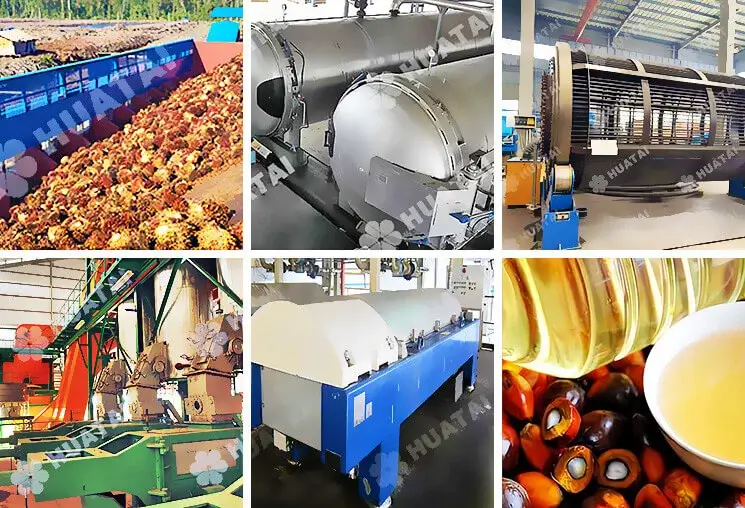
Palm Oil Production Steps
From fresh fruit bunches to refined palm oil and fractionated products.
The line runs through 8 stages. The strip gives the sequence at a glance; the notes below cover temperatures, pressures and yields for each stage.
1. Sterilization
Fresh fruit bunches are sterilized with live steam at 140-145°C (0.25-0.30 MPa) for 75-90 minutes in horizontal autoclaves. This deactivates lipase enzymes, loosens fruit from the stalk, and softens the mesocarp.
2. Threshing
Sterilized bunches enter a rotating threshing drum where mechanical agitation separates individual fruits from empty bunch stalks. Empty bunches are conveyed to the boiler as fuel.
3. Digestion
Fruits are heated to 90-95°C and mechanically stirred in a steam-jacketed vertical digester to rupture oil cells and release oil from the mesocarp fibers.
4. Pressing
Digested mash is fed into twin-screw presses. Oil is expelled from the mesocarp at 0.8-1.5 MPa cone pressure while fiber and nuts are separated for further processing.
5. Clarification
Crude oil from presses is mixed with hot water, then passed through a series of settling tanks and centrifugal purifiers to separate oil from sludge and fine solids.
6. Refining
Physical or chemical refining options: degumming removes phospholipids, bleaching removes pigments, and deodorization at 240-260°C under 3-5 mbar vacuum removes free fatty acids and odors.
7. Fractionation
RBD palm oil is crystallized under controlled cooling and filtered through membrane filters. The liquid fraction (olein) is used for cooking and frying; the solid fraction (stearin) is used for margarine and shortening.
Plant Capacity & Output
Indicative design windows. Final figures are fixed against your fruit supply, bunch quality and site conditions during engineering.
| FFB Processing Capacity | 10-2000 TPD fresh fruit bunches, from village-scale mills to full industrial complexes |
|---|---|
| Oil Extraction Rate (OER) | 20-24% on FFB weight, depending on bunch quality and ripeness at intake |
| Kernel Extraction Rate (KER) | 4-6% — kernel recovered from press cake via nut cracking and separation |
| Sterilization | 140-145°C at 0.25-0.30 MPa saturated steam, 75-90 minutes per cycle |
| Digestion & Pressing | 90-95°C digestion; twin-screw press at 0.8-1.5 MPa cone pressure |
| Vacuum Drying | CPO moisture reduced below 0.1% before storage or refining |
| Deodorization | 240-260°C under 3-5 mbar vacuum for physical refining |
| Energy Balance | Steam raised from shell and mesocarp fibre; typically 0.5-0.7 t steam and 18-25 kWh per tonne FFB |
Key Equipment Systems
Each system is designed and manufactured in-house under ISO 9001 quality management.
| Sterilization Station | Horizontal autoclaves with triple-peak cycle control, automatic pressure regulation, and condensate recovery. Configurable for single-peak, double-peak, or triple-peak sterilization cycles depending on fruit variety. |
|---|---|
| Threshing Drum | Rotating drum thresher with adjustable speed and internal lifting bars for efficient fruit detachment. Integrated empty bunch conveyor for boiler fuel supply. |
| Digester & Pressing | Steam-jacketed vertical digester with multi-arm stirring mechanism and live steam injection. Followed by twin-screw press with variable speed drive and automatic cone pressure regulation. |
| Clarification System | Continuous settling tank with oil skimming, sludge centrifuge for oil recovery, and oil purifier for final polishing. Includes vacuum dryer to reduce moisture below 0.1%. |
| Fractionation Plant | Crystallizer tanks with precise temperature control, membrane filter press, and olein/stearin collection tanks. Dry fractionation process with no chemical additives. |
| Refining Plant | Physical refining system with pre-treatment, bleaching earth dosing and filtration, and packed-column deodorizer. Chemical refining alternative available with centrifugal neutralization. |
Technical Highlights
Engineering innovations for superior palm oil milling and refining.
Triple-Peak Sterilization
Our advanced sterilization system uses a three-peak pressure cycle that ensures complete enzyme deactivation while minimizing oil loss in condensate. This technology achieves over 95% fruit loosening efficiency.
High OER with Low Oil Loss
Optimized pressing and clarification design achieves oil extraction rates above 20% OER (oil-to-bunch ratio) with oil loss in effluent below 0.5%, maximizing mill profitability.
Energy Self-Sufficient Mill Design
Our mills utilize palm kernel shells and mesocarp fiber as boiler fuel, generating all required steam and electricity for the entire operation. Steam is raised from shell and fibre, so a well-run mill buys little or no outside energy. Excess power can be exported to the grid.
Why Buyers Choose Huatai
Since 1988 we have designed, built and commissioned complete oil mill and refining plants worldwide — one partner from layout to handover.
ISO 9001 certified manufacturing · EPC turnkey delivery · 48-hour proposal turnaround
Frequently Asked Questions
Straight answers to the questions buyers ask us before placing an order.
What capacity of palm oil line do you deliver?
From 5 TPH FFB (smallholder mill) to 60 TPH (industrial plantation scale). We deliver both turnkey mills and the downstream refining/fractionation train.
Can you deliver a complete palm oil mill or just one section?
Both. We can deliver the upstream mill (sterilizer → thresher → press → clarification) or the downstream refining + fractionation train, or the full integrated line.
What is the oil yield from FFB?
20-24% by weight. The exact number depends on the FFB ripeness and the press efficiency. Our presses achieve 18-20% oil extraction from the mesocarp.
How do you handle empty fruit bunches (EFB)?
EFB is typically sent to a boiler as fuel (replacing fossil fuels) or to a fiber recovery line. We can integrate either option. Pelletizing EFB for export is also popular in Indonesia and Malaysia.
What about palm oil mill effluent (POME)?
We provide a complete POME treatment train: cooling → anaerobic digestion → biogas capture → aerobic polishing. Biogas can be used as fuel for the boiler, closing the energy loop.
Do you deliver to both Indonesia and Africa?
Yes. Our palm oil references include Indonesia, Malaysia, Thailand (downstream), Congo, Nigeria, Ghana, Côte d'Ivoire, and Cameroon.
What capacity should I choose for a Palm Oil Production Line?
Capacity depends on how much raw material you can secure year-round, not on how much you would like to sell. Tell us your daily or monthly feedstock availability, the local season pattern and your target market, and we size the line so it runs near full load most of the year instead of sitting idle between harvests.
Can the line be expanded later?
Yes. We build these plants in modules, so you can start with pressing and add solvent extraction, refining or fractionation once volume justifies it. We reserve the floor space, utility capacity and pipe racks for the later stages during the first installation, which costs very little at the time and saves a rebuild later.
Do you handle installation and training for a Palm Oil Production Line?
We deliver on an EPC turnkey basis. Our engineers supervise foundation setting, erection and commissioning on site, run the line through performance testing, and train your operators and maintenance crew before handover. You receive a running plant, not a crate of parts.
What about spare parts and after-sales support?
Wear parts for the presses, filters and pumps are stocked as standard and ship with the plant as a recommended spares package. After commissioning our team stays reachable for remote troubleshooting, and we can place a service engineer on site for major overhauls.
How long does delivery take?
Lead time depends on capacity, configuration and how much custom engineering your site needs. Rather than quote a number that will not hold, we confirm a firm design, manufacturing and shipping schedule alongside the proposal, broken down by stage so you can plan civil works around it.
What do you need from me to prepare a quotation?
Three things are enough to start: your raw material and its typical oil content, your target capacity in tonnes per day, and the destination port or country. Send those over and we come back with a process flow, equipment list and budget estimate. Send your requirements on WhatsApp and we will take it from there.
Get Your Customized Palm Oil Plant Solution
Tell us your target FFB capacity and product requirements. Our engineers will prepare a tailored proposal within 48 hours.
Send Us a Message
Fill in your project details below — our engineering team typically responds within 48 hours with a customized proposal and preliminary process flow diagram.