
Premium Aromatic Oil Production
Peanut oil (also known as groundnut oil) is one of the most popular cooking oils worldwide, prized for its rich nutty flavor and high smoke point. With an oil content of 45-55%, peanuts are an excellent feedstock for mechanical pressing-based oil production. Huatai's peanut oil production lines are engineered to preserve the natural aroma and flavor profile. Our hot-press technology at precisely controlled temperatures develops the characteristic roasted peanut fragrance, while cold-press options are available for natural, minimally processed oil. We offer complete lines from 5 TPD for small and medium processors to 500 TPD for large-scale operations. Each line includes cleaning, shelling, crushing, cooking, pressing, filtration, and optional refining — all integrated for continuous, efficient production.
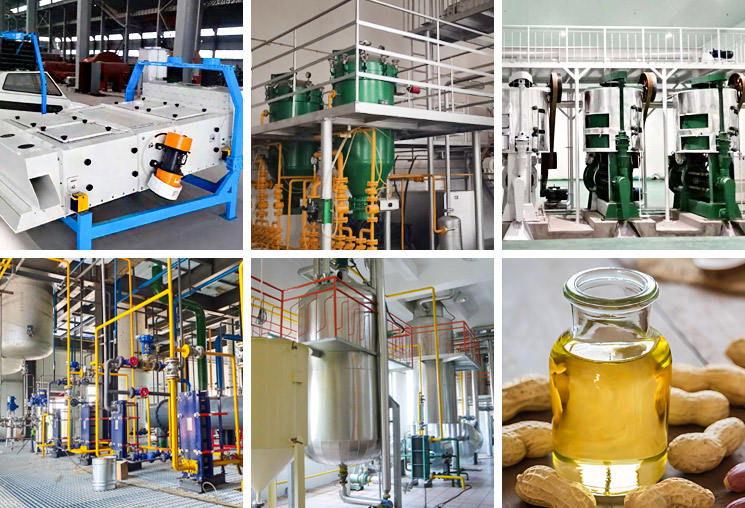
Peanut Oil Production Steps
From raw peanuts to aromatic, crystal-clear peanut oil.
The line runs through 8 stages. The strip gives the sequence at a glance; the notes below cover temperatures, pressures and yields for each stage.
1. Cleaning
Raw peanuts pass through magnetic separators, vibrating screens, and destoners to remove stones, metal, dust, and other foreign materials.
2. Shelling
Peanuts are shelled using a disc or roller sheller to separate kernels from shells. Shells can be used as biomass fuel or animal bedding.
3. Crushing
Shelled peanut kernels are crushed into 3-4 mm particles using a toothed roller crusher to increase surface area for efficient oil release.
4. Cooking
Crushed peanut meal is heated and conditioned at 110-130 deg C in a multi-layer cooker with live steam injection. This ruptures oil cells, reduces moisture to 5-7%, and develops the characteristic roasted aroma.
5. Pressing
Cooked meal is fed into a series of screw oil expellers. Primary pressing extracts the bulk of oil at high pressure, followed by secondary pressing to recover residual oil.
6. Filtration
Crude peanut oil passes through plate-and-frame filter presses or leaf filters to remove fine solids and produce clear, golden peanut oil ready for consumption or further refining.
7. Refining
Optional refining section: degumming removes phospholipids, neutralization reduces free fatty acids, bleaching lightens color, and deodorization removes odors for fully refined peanut oil.
Key Equipment Systems
Each system is designed and manufactured in-house under ISO 9001 quality management.
| Cleaning & Shelling | Magnetic separator, vibrating screen, destoner, disc sheller or roller sheller with aspiration system for shell-kernel separation. Adjustable shelling gap for different peanut varieties and sizes. |
|---|---|
| Crushing & Cooking | Toothed roller crusher producing uniform 3-4 mm particles. Multi-layer vertical cooker with indirect steam heating and direct steam injection, equipped with automatic temperature and moisture control system. |
| Pressing System | Series of screw oil expellers (primary and secondary) with adjustable shaft speed and cage pressure. Double-stage pressing achieves residual oil in cake below 6-7%, maximizing oil recovery. |
| Filtration System | Plate-and-frame filter press or vertical pressure leaf filter with fine filter cloth. Includes oil transfer pumps, buffer tank, and clean oil storage tank. Filtered oil clarity meets commercial standards. |
| Refining Equipment | Complete refining line: degumming tank, centrifugal neutralization system, vacuum bleaching tank with closed filtration, and continuous deodorizer. Optional winterization for cold-test stable oil. |
Technical Highlights
Engineering innovations for superior peanut oil quality and efficiency.
Aroma Preservation Technology
Precision-controlled cooking at 110-130 deg C with optimized moisture profile develops and preserves the signature roasted peanut aroma, prized by consumers in Asian and Middle Eastern markets.
Dual Hot/Cold Press Options
Flexible line design accommodates both hot-press (aromatic) and cold-press (natural) processing modes. Hot press achieves 45-48% oil yield; cold press produces minimally processed premium oil at 32-35% yield.
High-Protein Peanut Cake
Our pressing process produces peanut cake with 45-48% protein content and 6-7% residual oil, an excellent high-value ingredient for animal feed, protein concentrates, and food applications.
Why Buyers Choose Huatai
Since 1988 we have designed, built and commissioned complete oil mill and refining plants worldwide — one partner from layout to handover.
ISO 9001 certified manufacturing · EPC turnkey delivery · 48-hour proposal turnaround
Frequently Asked Questions
Straight answers to the questions buyers ask us before placing an order.
What capacity of peanut line do you offer?
From 5 TPD (small Senegal-style expeller line) to 500 TPD (industrial crushing + refining). Most African and Indian clients are in the 20-100 TPD range.
What is the oil yield from peanut?
45-50% by weight (kernel basis). With a good press + solvent extraction combination, residual oil in meal can be brought under 1%.
How is aflatoxin controlled in the line?
Three checkpoints: (1) incoming kernel inspection (reject visibly moldy), (2) UV or sorting at the cleaning stage, (3) low-temperature handling of meal. We design the line to minimize dust and mold growth points.
Is the meal safe for human consumption?
Partially defatted peanut meal is sold for animal feed (high-protein, ≥45%). For human consumption (peanut flour), additional processing (toasting, fine grinding) is needed and is usually done in a separate section.
Can the same line process soybean or sunflower?
Yes, with adjustments. Peanut has high oil content (45-50%) and requires pre-pressing + solvent extraction, while soybean is usually direct solvent. A dual-purpose line is possible but not optimal.
What is the refining yield for peanut oil?
Crude peanut oil has 0.5-1% gums and 0.5-2% free fatty acids. The refining loss is 4-6% of crude oil weight, depending on quality of incoming kernels.
What capacity should I choose for a Peanut Oil Production Line?
Capacity depends on how much raw material you can secure year-round, not on how much you would like to sell. Tell us your daily or monthly feedstock availability, the local season pattern and your target market, and we size the line so it runs near full load most of the year instead of sitting idle between harvests.
Can the line be expanded later?
Yes. We build these plants in modules, so you can start with pressing and add solvent extraction, refining or fractionation once volume justifies it. We reserve the floor space, utility capacity and pipe racks for the later stages during the first installation, which costs very little at the time and saves a rebuild later.
Do you handle installation and training for a Peanut Oil Production Line?
We deliver on an EPC turnkey basis. Our engineers supervise foundation setting, erection and commissioning on site, run the line through performance testing, and train your operators and maintenance crew before handover. You receive a running plant, not a crate of parts.
What about spare parts and after-sales support?
Wear parts for the presses, filters and pumps are stocked as standard and ship with the plant as a recommended spares package. After commissioning our team stays reachable for remote troubleshooting, and we can place a service engineer on site for major overhauls.
How long does delivery take?
Lead time depends on capacity, configuration and how much custom engineering your site needs. Rather than quote a number that will not hold, we confirm a firm design, manufacturing and shipping schedule alongside the proposal, broken down by stage so you can plan civil works around it.
What do you need from me to prepare a quotation?
Three things are enough to start: your raw material and its typical oil content, your target capacity in tonnes per day, and the destination port or country. Send those over and we come back with a process flow, equipment list and budget estimate. Send your requirements on WhatsApp and we will take it from there.
Get Your Customized Peanut Oil Plant Solution
Tell us your target capacity and product requirements. Our engineers will prepare a tailored proposal within 48 hours.
Send Us a Message
Fill in your project details below — our engineering team typically responds within 48 hours with a customized proposal and preliminary process flow diagram.