
Turning a By-Product into "Healthy Oil"
Rice bran oil is widely recognized as a "healthy oil" with an ideal fatty acid balance, rich in natural antioxidants including gamma-oryzanol, tocotrienols, and phytosterols. With global rice production exceeding 500 million metric tons annually, rice bran represents one of the most underutilized oil resources.
The critical challenge in rice bran processing is stabilization — fresh rice bran contains a highly active lipase enzyme that rapidly breaks down oil into free fatty acids, making it unsuitable for edible oil within hours. Huatai's patented expansion stabilization technology (Patent ZL200920089515.8) permanently deactivates this enzyme, enabling large-scale commercial processing.
Our complete rice bran oil lines cover stabilization, expansion, solvent extraction, degumming, dewaxing, and refining — producing premium rice bran oil with high oryzanol retention. Capacities range from 30 to 500 TPD of rice bran processing.
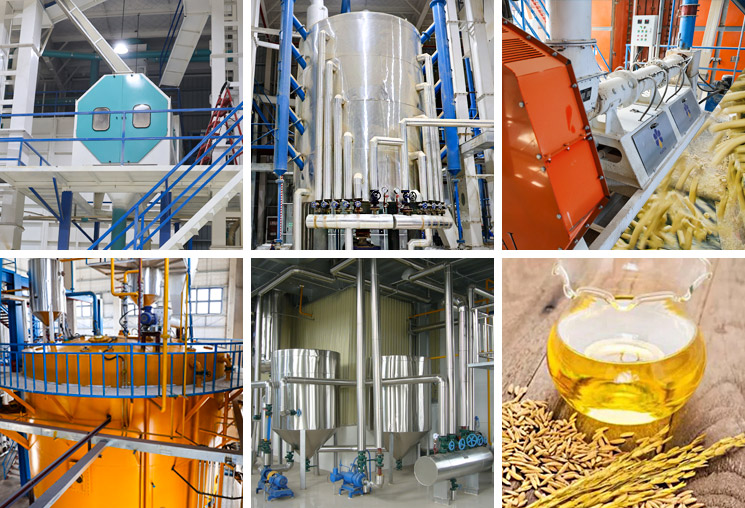
Rice Bran Oil Production Steps
From raw rice bran to premium healthy rice bran oil.
The line runs through 8 stages. The strip gives the sequence at a glance; the notes below cover temperatures, pressures and yields for each stage.
1. Stabilization Patented
Fresh rice bran enters our patented expansion stabilizer (Patent ZL200920089515.8) where high temperature, pressure, and mechanical shear permanently deactivate the lipase enzyme. This critical step prevents FFA rise from 5-8% to 20-30% within hours.
2. Expansion
Stabilized rice bran is further expanded into porous pellets (collets) with high internal surface area. This significantly improves solvent penetration and extraction efficiency while maintaining good percolation in the extractor bed.
3. Solvent Extraction
Expanded bran is extracted with hexane in a continuous extractor. The porous pellet structure enables rapid and complete oil removal, achieving residual oil below 1% in de-oiled bran.
4. Degumming
Crude rice bran oil is degummed to remove phospholipids and gums. This reduces refining losses and prepares the oil for subsequent processing steps.
5. Dewaxing
Rice bran oil contains 2-4% high-melting waxes. Oil is chilled to 5-8 deg C in crystallizers to precipitate wax crystals, then filtered — essential for clear, haze-free bottled oil.
6. Refining
Physical refining at high temperature and vacuum removes free fatty acids while preserving natural gamma-oryzanol. Chemical refining alternative available for high-FFA crude oil. Final product is light-colored, stable, and nutritionally rich.
Key Equipment Systems
Each system is designed and manufactured in-house under ISO 9001 quality management.
| Bran Stabilization System Patent ZL200920089515.8 | Patented expansion stabilizer with controlled high-temperature, high-pressure, and high-shear conditions. Permanent lipase enzyme deactivation with no chemical additives. Throughput capacities from 30 to 500 TPD. |
|---|---|
| Expander System | Secondary expander producing porous collets with optimized density (450-550 kg/m3) for ideal solvent percolation. Adjustable die configuration for different bran characteristics. |
| Solvent Extraction | Continuous chain-type extractor with deep-bed design for fine-particle rice bran. Complete miscella evaporation, mineral oil absorption, and solvent recovery system. Explosion-proof design throughout. |
| Dewaxing System | Crystallizer tanks with precise temperature ramp control, membrane filter press for wax separation. Produces cold-test stable oil passing 0 deg C / 5.5-hour test. |
| Refining Plant | Physical refining system with pre-stripping, packed-column deodorizer/deacidifier, and high-efficiency scrubber for fatty acid distillate recovery. Preserves natural oryzanol and tocopherols in the final oil. |
Technical Highlights
Patented technology and engineering innovations for rice bran oil processing.
Patented Stabilization Technology
Patent ZL200920089515.8 — our expansion stabilization process permanently deactivates lipase enzyme in seconds. Treated bran maintains FFA below 5% for months, compared to untreated bran which reaches 20-30% FFA within 24 hours.
High Oryzanol Retention
Our physical refining process preserves up to 90% of natural gamma-oryzanol in the final oil (compared to chemical refining which strips most of it). Oryzanol is a potent antioxidant with proven cholesterol-lowering benefits.
Complete By-Product Utilization
De-oiled rice bran retains 16-18% protein and is an excellent feed ingredient. Wax by-products have applications in cosmetics and food coatings. Gum by-products can be processed into lecithin for additional revenue.
Energy-Efficient Design
Integrated heat recovery throughout the process reduces steam consumption by approximately 25% compared to conventional rice bran plants. De-oiled bran can be burned as fuel in the boiler for energy self-sufficiency.
Why Buyers Choose Huatai
Since 1988 we have designed, built and commissioned complete oil mill and refining plants worldwide — one partner from layout to handover.
ISO 9001 certified manufacturing · EPC turnkey delivery · 48-hour proposal turnaround
Frequently Asked Questions
Straight answers to the questions buyers ask us before placing an order.
Why does rice bran need stabilization?
Fresh rice bran contains a very active lipase enzyme that breaks down the oil into free fatty acids within hours. Stabilization (extrusion or steam heating) inactivates the lipase and preserves the oil for later extraction.
What is the oil content of rice bran?
15-22% depending on the rice variety and the milling process. Stabilized bran is typically 18-20%.
How soon after milling must the bran be processed?
Within 2-4 hours if unstabilized. With stabilization (extrusion), the bran can be stored for weeks before extraction — a key advantage for mills that want to accumulate bran before processing.
What is γ-oryzanol and is it worth recovering?
γ-Oryzanol is a plant sterol complex found in rice bran oil, sold as a nutraceutical for cholesterol management and skin care. It is concentrated in the soapstock during refining. We can deliver a γ-oryzanol recovery unit as an add-on.
What's the refining yield for rice bran oil?
Crude rice bran oil has high FFA (5-15% in unstabilized bran, 2-5% in stabilized). Refining loss is 8-12% — significantly higher than other oils due to wax removal and FFA neutralization.
How do you handle the wax?
Wax is removed in two stages: (1) winterization at 5-10°C, (2) adsorption on bleaching earth. Our refining line includes a wax removal train that brings the wax content to under 50 ppm.
What capacity should I choose for a Rice Bran Oil Production Line?
Capacity depends on how much raw material you can secure year-round, not on how much you would like to sell. Tell us your daily or monthly feedstock availability, the local season pattern and your target market, and we size the line so it runs near full load most of the year instead of sitting idle between harvests.
Can the line be expanded later?
Yes. We build these plants in modules, so you can start with pressing and add solvent extraction, refining or fractionation once volume justifies it. We reserve the floor space, utility capacity and pipe racks for the later stages during the first installation, which costs very little at the time and saves a rebuild later.
Do you handle installation and training for a Rice Bran Oil Production Line?
We deliver on an EPC turnkey basis. Our engineers supervise foundation setting, erection and commissioning on site, run the line through performance testing, and train your operators and maintenance crew before handover. You receive a running plant, not a crate of parts.
What about spare parts and after-sales support?
Wear parts for the presses, filters and pumps are stocked as standard and ship with the plant as a recommended spares package. After commissioning our team stays reachable for remote troubleshooting, and we can place a service engineer on site for major overhauls.
How long does delivery take?
Lead time depends on capacity, configuration and how much custom engineering your site needs. Rather than quote a number that will not hold, we confirm a firm design, manufacturing and shipping schedule alongside the proposal, broken down by stage so you can plan civil works around it.
What do you need from me to prepare a quotation?
Three things are enough to start: your raw material and its typical oil content, your target capacity in tonnes per day, and the destination port or country. Send those over and we come back with a process flow, equipment list and budget estimate. Send your requirements on WhatsApp and we will take it from there.
Get Your Customized Rice Bran Oil Plant Solution
Tell us your target capacity and product requirements. Our engineers will prepare a tailored proposal within 48 hours.
Send Us a Message
Fill in your project details below — our engineering team typically responds within 48 hours with a customized proposal and preliminary process flow diagram.