
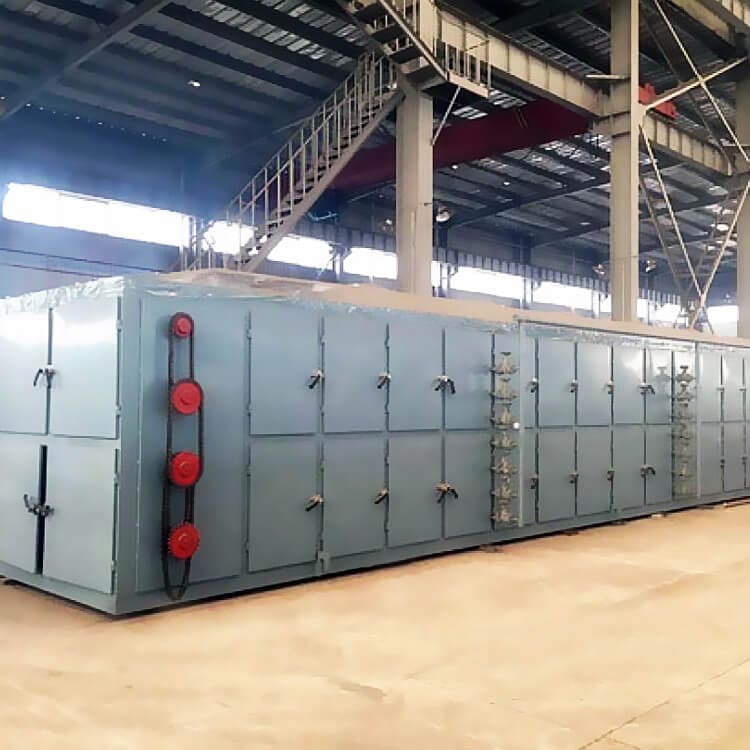
Ask ten suppliers what an edible oil mill contains and you get ten lists. Each mirrors a particular order book, not a different process. Four sections do the actual work; everything else feeds them, cools them, cleans them or keeps them running.
Name those four and a quotation stops being a wall of unfamiliar nouns.
The four sections of every mill
Pretreatment prepares seed. Pressing squeezes oil out mechanically. Solvent extraction pulls the remainder from cake with a hydrocarbon solvent, then strips that solvent back out. Edible oil refining removes whatever makes pressed oil cloudy, dark or short-lived.
Not every project needs all four. A specialty operation may stop after pressing. A crushing plant on high-oil seed often runs press plus solvent. Bottlers and margarine producers want the full chain. Fix where your project stops first; that boundary dictates civil works, boiler rating and headcount.
Pretreatment equipment
This section earns less attention than it deserves. Seed that cleans and flakes evenly is the difference between a press running all shift and one choking every hour.
Typical order: a cleaning deck removing stones, chaff and tramp metal, a sheller for cottonseed or sunflower, a crusher breaking large kernels, a flaking roll producing a thin uniform sheet, then a conditioner or roasting drum adjusting moisture and heat. Puffing equipment appears wherever the downstream solvent stage needs a porous flake.
Flake thickness governs how completely solvent reaches the oil cells; conditioner control governs how much oil a press releases without scorching meal. Spend on instrumentation rather than tonnage, since tight moisture control outperforms extra capacity.
Our pretreatment equipment range covers that sequence from intake to conditioned flake.
Pressing equipment
Screw presses dominate. A rotating worm shaft inside a cage compresses flake, oil drains through the barrel, cake exits the choke. Hydraulic presses survive in small workshops where batches matter more than throughput.
Nameplate tonnage rarely separates a good press from a mediocre one. Barrel metallurgy, cage clearance, choke adjustment and cooling decide how long it runs before an operator stops to clean it. A press sized generously runs cooler and lasts longer than one pushed to its ceiling.
Above roughly thirty tonnes daily, pressing becomes a first stage. The press takes the easy oil; cake moves to solvent.
Solvent extraction equipment
Extraction recovers what pressure leaves behind. The set: an extractor, submerged or percolation type, a desolventiser-toaster drying meal, an evaporation train concentrating the oil-solvent mixture, and a recovery system condensing solvent for reuse.
Solvent loss is the figure operators watch, since every kilogramme escaping costs twice: purchased solvent gone, vapour leaving the plant. Flange tightness, gasket quality, condenser performance and vacuum held on the evaporation train all surface there.
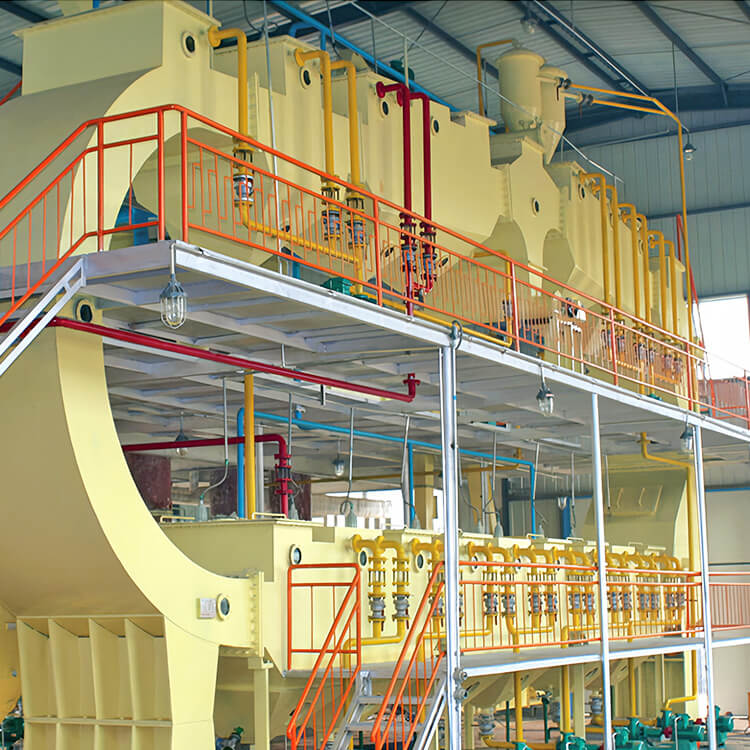
Safety shapes layout more than any other section. Solvent vapour is heavier than air and explosive in a narrow band, so electrical classification, ventilation, gas detection and distance between the extraction bay and any ignition source are design decisions, not add-ons.
Our solvent extraction equipment page sets out that chain.
Edible oil refining equipment
Edible oil refining removes gums, free fatty acids, colour bodies and odour. Degumming, neutralising, bleaching, deodorising: four stages, each with its own vessel, pump and control loop.
Two routes exist. Chemical neutralising uses caustic soda and suits oils carrying a heavy free fatty acid load. The physical route relies on steam stripping under vacuum and suits oils where that load is light and gums can be handled upstream. Choose by material, not habit; a route forced onto the wrong oil wastes product at every stage.
Dewaxing sits alongside for sunflower, rice bran and corn germ oil, where waxes cloud a bottle in a cold warehouse. Winterising and dewaxing share one principle: chill, hold, separate.
Our edible oil refining equipment section lists the vessels and ancillary systems.
Utilities and support systems
The four sections cannot run alone. A boiler supplies steam for conditioning, deodorising and the desolventiser; cooling towers dump heat from condensers and vacuum systems. Compressed air drives valves. Effluent treatment handles wash water and spent caustic.
Buyers forget electrical load. Motors on presses and extraction pumps draw hard at start-up, and a transformer sized on running load alone will trip. Ask for a load schedule early, then hand it to the electrical contractor before cable trays are fixed.
Trimming the list for your capacity
Capacity bands narrow the list quickly. Below roughly thirty tonnes daily, pretreatment plus pressing plus filtration is usually the whole plant. Between thirty and a hundred, solvent extraction starts earning its place on seed with modest oil content. Above that, continuous edible oil refining, automated control and full utilities become standard.
Trim by market, not ambition. Selling filtered oil to a local distributor needs no deodoriser. Supplying retail bottles needs filling, labelling and a lab bench for acidity and peroxide checks. Chasing an export contract may demand certification that changes nothing in the process but everything in the paperwork.
Working through an equipment list and want a second opinion on what to strike out? Send the oilseed, the capacity band you have in mind, and where your product stops. We will mark up sections you can defer and ones that must be sized together. +86 18337263319. No charge for the walk-through. Chat with us WhatsApp →
FAQ
Do I need solvent extraction if I already press the seed?
Not always. Pressing leaves oil in the cake, and the gap widens on seed with lower oil content. If that cake sells well as animal feed, the residual oil is a product rather than a loss. Extraction earns its place when cake volume is large enough that unrecovered oil equals real money, and when you have people who can run a hazardous area safely.
Which section is most often undersized?
Pretreatment, almost every time. Buyers reserve attention for presses and vessels, then accept a cleaning deck and flaking roll sized on a spreadsheet. Throughput collapses at the front end and every section downstream inherits the shortfall, including the boiler.
How much floor space does a complete plant need?
More than the machine footprint suggests. Add maintenance access around each vessel, a laydown area for spares, a control room, laboratory space and the statutory separation around the solvent bay. Sizing a shed from equipment drawings alone leaves nobody room to swing a wrench.
Can edible oil refining be added later?
Yes, if the building and utilities leave room. Structural steel, steam header and electrical capacity cost less to oversize at the start than to retrofit into a running plant. Decide the eventual endpoint now, even when you buy in stages.
What should I check before signing an equipment list?
That every item has a duty, a material of construction and an interface with its neighbours. Lists fail at the seams: a pump discharge matching no vessel inlet, a motor with no starter in the panel, a conveyor arriving at a wall. Read the list as a flow, not as a catalogue. Chat with us on WhatsApp, or call +86 18337263319.