
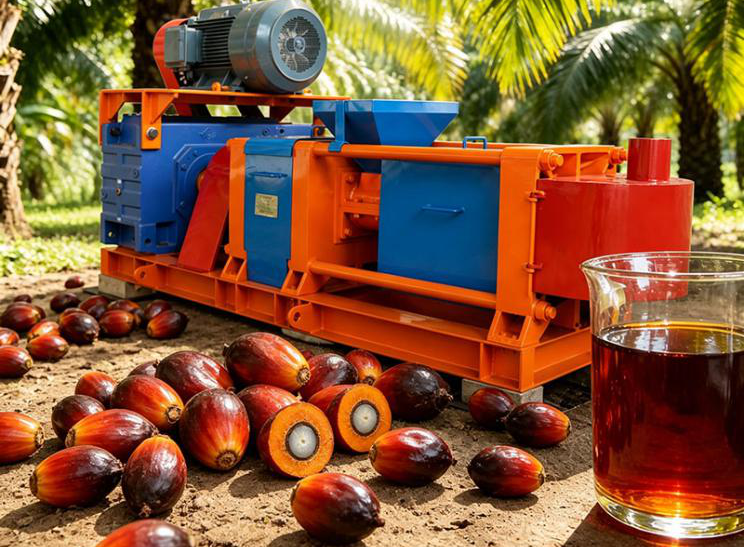
FFB Processing: Where Efficiency Begins at the Sterilizer
The modern palm oil mill plant starts not at the press but at the sterilizer — and the difference between a well-tuned sterilization circuit and a sloppy one can mean a full percentage point of oil loss. Sterilization serves three purposes: inactivating lipolytic enzymes that would spike free fatty acid levels, loosening fruit from the bunch for efficient threshing, and conditioning the nuts for kernel recovery.
Current best practice favors horizontal sterilizers with variable steam-pressure cycles tailored to FFB maturity and fruit looseness. A three-stage pressure profile — 2.8 bar hold, depressurization, then 3.0 bar re-hold — delivers thorough heat penetration without turning the fruit into mush that clogs downstream presses. The threshing drums that follow need careful calibration; overly aggressive threshing fractures nuts, while under-threshing leaves fruit attached to empty bunches and sends oil straight to the waste pile.
Experienced operators know that a well-configured clarification system can recover oil that less attentive mills lose. After pressing, the crude palm oil mixture passes through a clarification station where continuous settling tanks separate oil from sludge and water. A sand trap, a static separator, and a centrifugal clarifier working in series can push oil losses in effluent below 0.5% — a figure that older single-stage clarification setups rarely achieve.
POME: The Liability That Became an Asset
The real headline, though, is what happens to all that effluent. Raw POME carries a COD (chemical oxygen demand) of 50,000–65,000 mg/L. Discharging it untreated is both illegal and wasteful. Covered anaerobic lagoon systems, now standard in Malaysian and Indonesian mills, capture the methane POME naturally produces. A 60-ton-per-hour mill can generate 600–800 kW of electricity from POME biogas — enough to power the mill itself and export surplus to the grid.
Some palm oil mill plants have gone further. Thermophilic anaerobic digesters, with retention times as short as five days, produce biogas faster and in smaller footprints than conventional mesophilic lagoons. The treated effluent, still rich in nutrients, gets routed to the plantation as liquid fertilizer, closing the loop between factory and field.
Is your mill still ponding POME without energy recovery? The math is unforgiving: every cubic meter of POME that decomposes without capturing methane is both a climate liability and a missed revenue stream.
Pressing, Palm Oil Fractionation, and the Push for Higher Olein Yields
Downstream of the mill, fractionation is where margins get refined — literally. Dry fractionation of palm oil separates liquid olein from solid stearin without chemical additives. The process is elegantly simple: cool the oil under controlled conditions, crystallize the stearin fraction, and filter. Yet the devil lives in the crystallization curves. Too fast, and you get unstable crystals that pass through the filter; too slow, and plant throughput collapses.
Modern palm oil fractionation plants use programmable cooling with agitator speed control to target specific crystal polymorphs, achieving olein yields above 70% for crude palm oil with an iodine value around 52. For mills producing specialty fats, this precision is not optional — it is the difference between a commodity product and a premium one.
The palm oil fractionation step also reveals an often-overlooked synergy with the upstream extraction process. Crude palm oil with lower free fatty acid content — achieved through rapid sterilization and efficient clarification — produces cleaner crystal structures during fractionation, which in turn yields a higher proportion of premium olein. The entire palm oil mill plant, from sterilizer to fractionation column, operates as a single system. Weakness at any stage cascades downstream, shrinking margins at every step.
Henan Huatai Cereals and Oils Machinery, operating through oilmachineworld.com, supplies complete palm oil mill plant solutions from FFB sterilization through kernel recovery and dry fractionation. Their EPC turnkey projects cover capacities from small-scale 1 TPD installations up to 600 TPD edible oil refining lines, with a track record spanning Southeast Asia, West Africa, and Central America. Every line is engineered around the specific FFB varieties and local climate conditions of the project site.
Interested in a customized oil production line? Our engineering team is ready to prepare a tailored proposal for your specific requirements.