
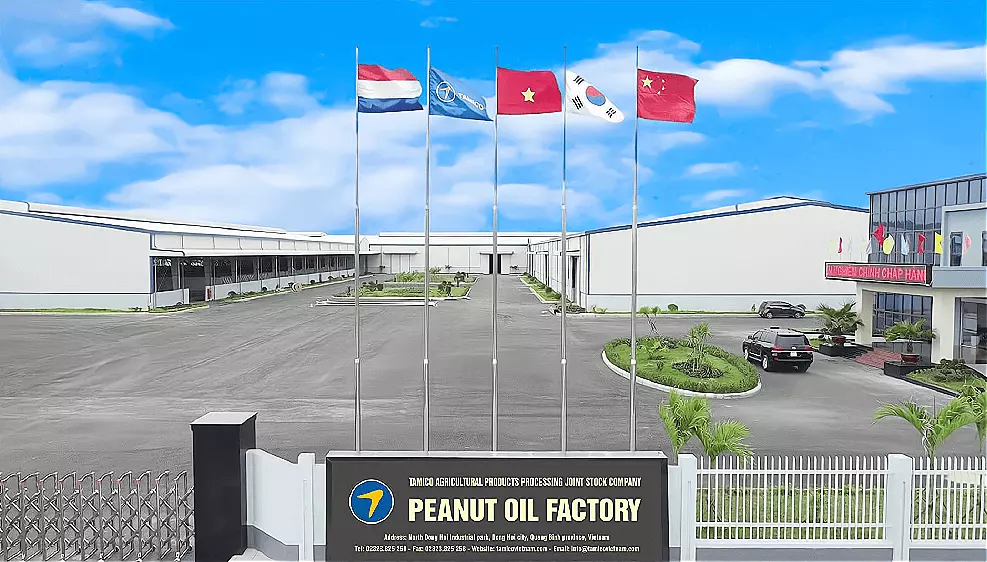
Co May Lai Vung Co. Ltd specialises in the production and processing of animal feed, poultry and aquatic products. Huatai supplied the rice bran and peanut oil processing equipment for the operation.
The combination is more deliberate than it first looks. Rice bran and groundnut sit on opposite ends of the oilseed calendar in Vietnam, so a line built to handle both runs more months of the year than a line built for either one alone.
Two feedstocks, one line: what that actually requires
A plant that processes both materials is not two plants bolted together. It is one plant with a few places where the process has to change. And those places are specific.
- Rice bran needs stabilising, groundnut does not. Fresh rice bran carries active lipase that drives free fatty acids up fast. Groundnut has no such problem. So the stabilisation step sits on the bran route and is bypassed for groundnut — which means the bypass has to be designed in, not improvised with a valve and a hope.
- Preparation is different. Bran is already small and dusty. It goes straight to conditioning and pelleting. Groundnut arrives as kernels and needs cracking, rolling and cooking first.
- Extraction is shared. Both materials go through the same solvent extraction section, which is where the capital sits and why sharing it makes economic sense.
- Refining has to handle both. Bran oil is waxy and high in FFA; groundnut oil is relatively clean. The refinery is specified for the harder of the two, with the understanding that the groundnut campaign will run with lower earth consumption.
The meal side matters more here
For a company whose core business is animal feed, poultry and aquatic products, the oil is only half the output. Defatted rice bran meal and groundnut cake are feed ingredients, and they are produced in far larger volume than the oil.
That flips the usual priority. On a plant built purely to sell oil, the meal is a by-product. Something to get rid of. On this one, meal specification — protein content, residual oil, how well it stores in a humid climate — is a product requirement, and the DTDC section and the meal handling downstream have to be specified accordingly rather than inherited from an oil-only design.
Running two or three raw materials? Send us the list and your monthly tonnage — we will tell you what can share equipment and what cannot.
Discuss a multi-feedstock plantHumidity and storage
Vietnam is humid. Both materials suffer for it. Rice bran goes rancid. Groundnut goes mouldy and picks up aflatoxin.
On a plant in this climate, drying capacity and covered storage are not site amenities — they are process equipment, they belong in the process flow diagram, and they should be budgeted as such from the start instead of being discovered as a problem in the first rainy season.
If you are looking at rice bran oil or groundnut oil processing in South-East Asia, send us your raw materials, tonnage and expected operating months. We will come back with a process configuration and a budget range.
Interested in a customized oil production line? Our engineering team is ready to prepare a tailored proposal for your specific requirements.