
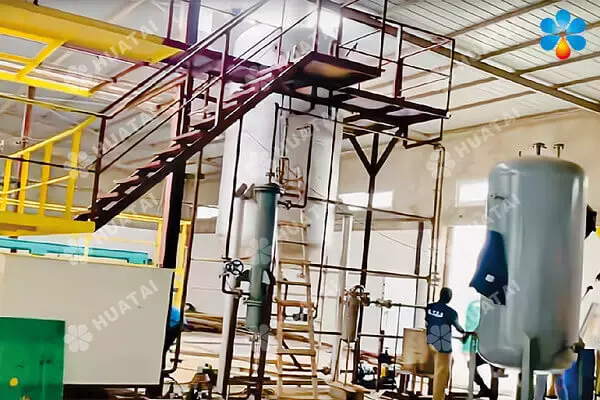
The customer, SOCIETE DE TRANSFORMATION DARACHIDE RAFFINEE-INDUSTRIES SUARL, works across processing, storage and distribution of groundnut products, import and export of products and equipment, and related trading. Huatai supplied a 30 tons per day peanut shelling, oil extraction and refining line.
Groundnut is a crop with a storage problem
Senegal grows groundnut, and has done for a long time. The constraint has never been the crop. It is what happens to it between harvest and processing.
Groundnut goes mouldy when it is stored damp. The mould produces aflatoxin. And aflatoxin gets shipments rejected at borders — not downgraded, rejected.
Aflatoxin survives refining poorly enough that prevention is the only real control: dry to safe moisture quickly, store dry, sort out damaged kernels. Do those three things and you are fine. Skip one and you have a problem that no amount of downstream equipment will fix.
Any groundnut project that treats storage as somebody else’s problem is setting itself up for a rejected lot. Usually in year two, when the first big shipment goes out.
That is why shelling sits at the front of this line rather than being treated as a separate activity done elsewhere. Shelling on site means the kernels go into drying and then into processing on a known schedule, instead of sitting in bags for an unknown number of weeks.
The process
- Shelling and cleaning — de-stoning, shelling, kernel separation, and sorting to pull damaged and discoloured kernels before they reach the oil.
- Crushing and cooking — kernels are cracked and rolled, then conditioned. Groundnut cooks differently from most oilseeds. High in oil, low in fibre. It goes from under-cooked to scorched fast, and the window between the two is narrower than most operators expect when they come from soybean or rapeseed.
- Pressing — screw pressing takes the oil down to a cake with roughly 6–8% residual oil. Whether that is good enough depends on one thing: what you can sell the cake for.
- Refining — degumming, neutralising, bleaching and deodorising to bring the oil to edible specification.
Pressing alone or pressing plus extraction
This is the decision that shapes a 30 T/D groundnut plant more than any other, and it is worth being blunt about.
Pressing leaves 6–8% oil in the cake. Adding solvent extraction gets that down to under 1%. On 30 T/D of groundnut, that is a meaningful amount of extra oil per year — but extraction is a serious capital addition, it brings solvent handling and safety requirements with it, and it only pays if the plant actually runs most of the year.
Groundnut is seasonal. A plant that runs four months a year because that is when the crop is in will struggle to justify an extraction section that has to be paid for twelve months a year. A plant with storage that lets it run ten months a year is a completely different calculation. We tell customers to work out their real operating months first. Before they decide anything. It is an expensive thing to get wrong, and by the time you find out, the concrete is poured.
Tell us your groundnut tonnage and how many months a year you expect to run. We will size the pressing and extraction sections honestly.
Ask about a groundnut plantWhat we delivered
Turnkey scope: process design, equipment manufacture, shipping, installation, commissioning and operator training. More detail on how the groundnut process is configured is on our peanut oil solution page.
If you are evaluating a groundnut project, the first question is not the equipment. It is how many months of the year you can keep the plant fed. Everything else — press-only or press-plus-extraction, plant size, payback — follows from that.
Interested in a customized oil production line? Our engineering team is ready to prepare a tailored proposal for your specific requirements.