
IGASA is part of the PALMAS Group, a leading Peruvian producer working across the sustainable cultivation and processing of oil palm, soybean and cocoa beans. IGASA itself manufactures and sells soaps, animal and vegetable fats, candles and related products.
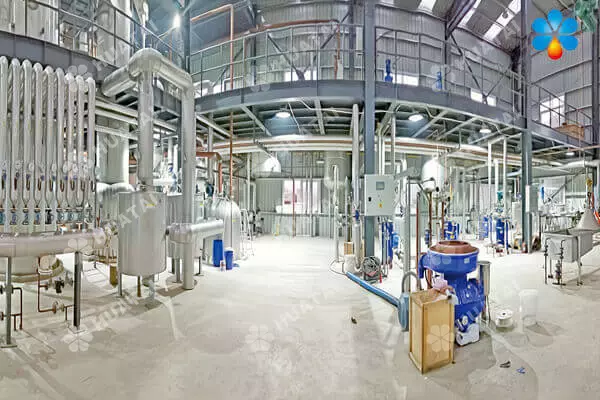
Huatai supplied a full continuous physical refining line for the operation.
Physical refining versus caustic: the real trade-off
The choice between physical and caustic refining is not a matter of taste. It comes down to the free fatty acid content of the incoming oil and how much yield loss you are willing to accept.
Caustic refining neutralises FFA with sodium hydroxide. It works on almost any feedstock, but the FFA leaves as soapstock, and soapstock drags neutral oil with it. Physical refining instead strips FFA in the deodoriser under vacuum at high temperature — no caustic, no soapstock, no effluent stream to treat. The trade-off is that it only pays on low-FFA oil, and it demands better pretreatment.
- Lower neutral oil loss. No soapstock means no oil dragged out with it. On a continuous line running year-round, that difference compounds.
- No caustic, no effluent. No soapstock acidification plant, no wastewater stream loaded with sulphates. For a site with tight discharge limits this is often the deciding factor.
- Higher deodoriser duty. Stripping FFA thermally needs higher temperature and deeper vacuum than a straight deodorise, so steam and vacuum systems have to be specified for it.
- Stricter feedstock discipline. Physical refining does not forgive poor degumming. Residual phosphorus has to be low before the oil reaches the deodoriser, or the product colour drifts.
Why continuous, at this scale
Batch refining makes sense when a plant switches feedstock often or runs short campaigns. A continuous line pays when you are running the same oil day after day and want steady utilities — steady steam draw, steady vacuum load, steady product quality. For an operation supplying fats to soap and candle manufacture as well as edible applications, that consistency is the point.
Continuous operation also means the bleaching earth dosage and the deodoriser conditions can be tuned once and then held, rather than re-set every batch. Operators stop fighting the plant.
Tell us your feedstock and FFA range on WhatsApp — we will tell you honestly whether physical refining pays for your oil, or whether caustic is the better choice.
Ask about physical refiningWhat Huatai built
The scope covered the full continuous refining train: degumming and bleaching ahead of the deodoriser, a continuous deodorising column sized for physical refining duty, vacuum generation, heat recovery, and the control system tying it together.
For palm in particular, physical refining pairs naturally with fractionation — splitting the refined oil into olein and stearin streams. You can read more about how that side of the process is configured on our palm oil solution page.
If you are weighing a refining line for palm, soybean or a mixed feedstock, the first question to settle is your FFA range. Everything else — yield, effluent, capital cost — follows from that one number.
Interested in a customized oil production line? Our engineering team is ready to prepare a tailored proposal for your specific requirements.
Project Specifications
Key data about this installation. The data sheet is included with the technical proposal we send during inquiry.
| Parameter | Value |
|---|---|
| Capacity | 50 T/D (refined oil) |
| Raw material | Crude sunflower oil |
| Final products | Refined sunflower oil, sunflower wax, PFAD |
| Location | Peru |
| Project type | Physical refining line |
| Commissioning year | 2022 |
Interested in a Similar Project?
Contact our engineering team to discuss your production requirements. We deliver customized EPC solutions worldwide.
Send Us a Message
Fill in your project details below — our engineering team typically responds within 48 hours with a customized proposal and preliminary process flow diagram.