
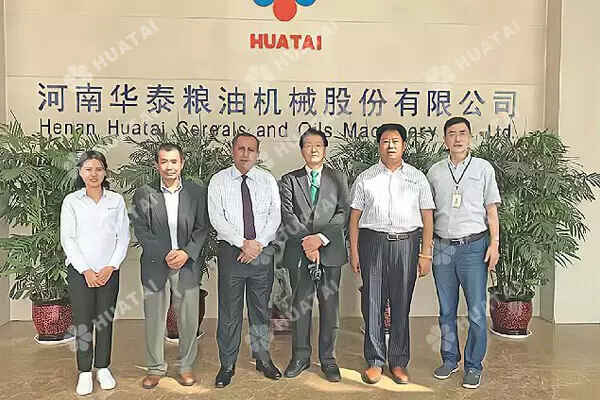
SANWAYUSHI Co. Ltd was founded in 1947. It is one of the earliest Japanese companies to work on rice bran oil processing — not just running a plant, but doing the research and development behind the technology. The company produces rice bran oil, and also runs deep-processing operations on the by-products that come out of it.
Huatai supplied automated equipment for the rice bran meal side of that operation: handling, conditioning and processing of defatted rice bran meal into animal feed.
The part of a rice bran plant nobody photographs
Rice bran oil gets the attention. The meal is where the tonnage is. After solvent extraction, defatted rice bran meal comes out of the DTDC at roughly 15–18% protein, and it either becomes a sold product or becomes a disposal cost. In a market like Japan, where feed formulation is precise and buyers test what they buy, that distinction is worth designing for.
Three things make rice bran meal harder to handle than soybean meal:
- It holds residual solvent and moisture unevenly. If the DTDC is not doing its job, you get pockets of meal that will not store — they heat, they go mouldy, and by the time anyone notices the whole lot is off-spec.
- It is dusty and low-density. Pneumatic handling needs to be sized for the actual bulk density, not the theoretical one, or you spend the plant’s life clearing blockages.
- Feed buyers specify tightly. Protein, fibre and residual oil all have to land in a band. A meal stream that drifts outside it stops being a product and becomes a blending problem.
What automation buys you here
The Japanese brief was specific about automation, and for good reason. Automated meal handling does three practical things on a line like this.
It keeps residence time and temperature consistent, which is what makes meal specification repeatable shift after shift. It takes people out of a dusty environment, which matters both for health and for housekeeping in a plant that also produces food-grade oil. And it gives a continuous record — temperatures, throughput, power draw — so when a buyer questions a batch, there is data to look at rather than a shrug.
Huatai has been pushing automation hard on large complete plants for years, mostly for environmental and low-carbon reasons. On a meal line the argument is simpler: consistency sells.
Planning a rice bran line? The meal side decides your revenue per ton. Send us your capacity and target meal spec on WhatsApp.
Ask about meal handlingWorth knowing before you specify a rice bran project
If you are evaluating rice bran oil equipment, budget the meal line properly from the start. It is tempting to treat it as downstream scaffolding. On a 100 T/D bran plant the meal is the larger volume by a wide margin, and retrofitting automated handling into a plant that was built around manual handling costs more than doing it once.
Interested in a customized oil production line? Our engineering team is ready to prepare a tailored proposal for your specific requirements.