
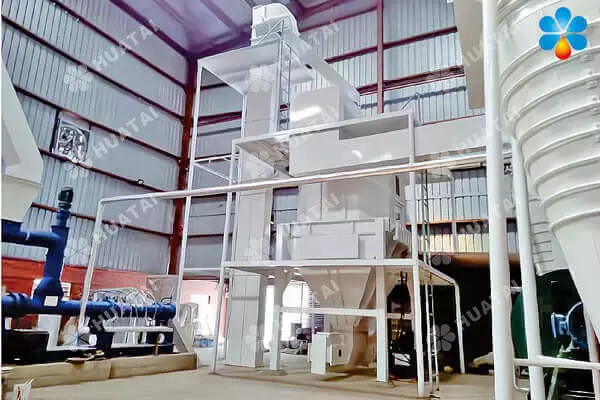
Bangladesh imports most of its edible oil, which is exactly why local refining capacity keeps getting built. Huatai has supplied equipment into that market for customers including the Meghna Group of Industries and MRT Agro Products BD, with lines running at around 100 tons per day across rice bran and other oilseeds.
Who the customers are
Meghna Group of Industries is one of the largest conglomerates in Bangladesh — more than 35,000 employees, around 6,000 distributors and some 15,000 suppliers, with annual turnover in the region of USD 2.5 billion. Its edible oil arm, Meghna Vegetable Oil Industries Ltd, was established at Meghnaghat, Narayanganj, in 1989.
MRT Agro Products BD produces edible oil including rice bran oil, and has grown into one of the larger private companies registered in Bangladesh, certified for quality and standard products in 2014.
Why rice bran is the awkward one
Rice bran behaves differently from soy or rapeseed. Radically different. Most of the trouble starts within hours of milling, not days.
Fresh rice bran carries an active lipase enzyme that splits the oil into free fatty acids at roughly 1% per hour under bad storage. Bran that leaves the mill at 4% FFA can arrive at the plant above 15%. Above that point physical refining stops being economic — you are pushed into caustic refining, which means soapstock, more effluent, and lower yield.
That single fact drives the whole design. Stabilisation is not an optional add-on for rice bran. It is the first step of the process.
- Bran stabilisation — live steam and heat treatment to deactivate lipase, holding the bran at temperature long enough to kill the enzyme without scorching it. Done properly, FFA rise is held to a fraction of a percent per day instead of per hour.
- Extraction — at 100 T/D of bran, solvent extraction is the only practical route. Pressing alone leaves 6–8% residual oil in the cake, and on this feedstock that is money left on the table.
- Refining — degumming, bleaching and deodorising, with the deodoriser under vacuum. Rice bran oil also carries wax and a high oryzanol content, and the winterisation step decides whether the bottled oil stays clear on a cool shelf.
Designing for how the plant will actually be run
Two things about these projects mattered more than the process flow itself. The first was steam. Fuel cost per ton of oil is the difference between a plant that runs and a plant that runs profitably, so the lines were specified with condensate recovery and sensible heat recovery rather than treating steam as an unlimited utility that magically appears from a boiler somebody else worries about.
The second was maintenance. A 100 T/D line in a market where a specific bearing or seal may take weeks to import cannot be built around proprietary parts. Wear items were standardised to sizes available locally wherever the design allowed it. Unglamorous work. It saves weeks of downtime over a plant’s life.
Rice bran, mustard, sesame, groundnut — send us your raw material and target capacity on WhatsApp for a process proposal.
Ask about a rice bran lineWhat a project like this includes
Huatai delivered these as turnkey scopes: process design, equipment manufacture, shipment, installation supervision, commissioning, and operator training. That last part is not a formality. Rice bran stabilisation, in particular, is a step where a well-built line still produces poor oil if the operator does not understand why the residence time matters.
If you are evaluating a rice bran or mixed-oilseed project in the 30–300 T/D range, the useful first question is not the equipment price. It is how far your bran travels and how long it sits before it reaches the plant — because that number decides whether your refinery makes money.
Interested in a customized oil production line? Our engineering team is ready to prepare a tailored proposal for your specific requirements.
Project Specifications
Key data about this installation. The data sheet is included with the technical proposal we send during inquiry.
| Parameter | Value |
|---|---|
| Capacity | 100 T/D |
| Raw material | Mixed oilseeds (soybean / mustard / rice bran) |
| Final products | Refined edible oil, oilseed meal |
| Location | Bangladesh |
| Project type | Multi-oilseed processing line |
| Commissioning year | 2023 |
Interested in a Similar Project?
Contact our engineering team to discuss your production requirements. We deliver customized EPC solutions worldwide.
Send Us a Message
Fill in your project details below — our engineering team typically responds within 48 hours with a customized proposal and preliminary process flow diagram.